
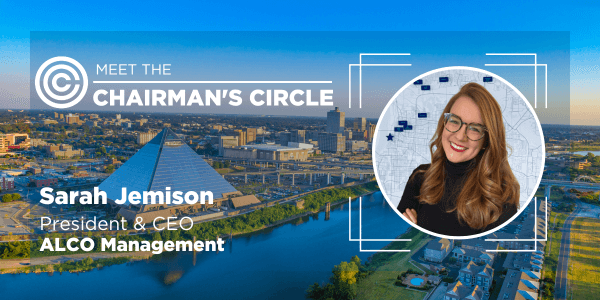
Sarah Jemison was not supposed to come back to Memphis.
A Princeton graduate with a resume rooted in federal housing policy, she had built a meaningful life in Washington, D.C., working on national advocacy for people with the fewest resources and the least margin for error. Memphis—her hometown, the place where her parents still live, where her father founded a successful property management company more than five decades ago—was not part of the plan.
“I didn’t initially intend to come back,” she said plainly. “I knew I loved affordable housing and enjoyed working in that field. But I was working on policy that was really removed from actual homes or actual people living in homes. It wasn’t tangible enough for me.”
That distance began to wear on her. In D.C., Sarah Jemison worked for the National Low Income Housing Coalition, focusing on the housing needs of people living far below the commonly cited “low income” threshold. In Memphis terms, that meant families earning $12,000 a year or less—people for whom even subsidized rent can feel precarious.
“We’d work on policy that may or may not come to fruition,” she said. “If we were lucky, our work might have an impact, but it would be something very far in the distance.”
Then came a conversation she nearly didn’t take.
Sarah Jemison agreed to meet with ALCO Management’s head of development, Berkeley Burbank, to talk—casually, she thought—about a potential role on the company’s development team. ALCO, founded by her father Frank Jemison in 1974, manages affordable housing across the Southeast. The meeting was meant to be exploratory.
“About five minutes into the conversation,” she recalls, “I was confident that I wanted to come home to Memphis, to ALCO and work on this team—to be in a position where I could work closely with actual homes and actual residents and actual communities.”
She joined Chairman’s Circle investor ALCO Management Inc. at the start of 2018. 
Since then, Sarah has served as chief strategy officer and chair of the board, helping guide a company that manages roughly 5,500 apartment homes across 55 communities, housing more than 20,000 people and employing more than 200 team members. On Jan. 1 she will become president and CEO.
ALCO has been based in Memphis for its entire 50-plus-year history, and Sarah Jemison is clear-eyed about what that longevity requires.
“We know our residents don’t have a lot of options, which means the market doesn’t necessarily dictate that we provide high-quality housing,” she said. “So it’s incumbent upon us to hold ourselves to a higher standard than demand would suggest— ensuring we provide residents a high-quality place to live, regardless of income.”
ALCO’s work focuses on renovating older properties through federal programs like Section 8 Rental Assistance and Low-Income Housing Tax Credits. Residents typically pay 30 percent of their income toward rent, with the federal government covering the rest.
“If someone is paying 30 percent of $12,000 a year,” she said, “they deserve the same dignity and quality as anyone else. Our community will be stronger as a whole if they have a secure foundation from which to build their lives.”
That philosophy extends beyond buildings. Under Sarah Jemison’s leadership, ALCO has expanded its emphasis on service coordination, partnerships with local nonprofits and employee development. Positions at ALCO range from roles requiring a high school diploma or GED to those requiring advanced degrees—and Sarah is intentional about making room for growth at every level.
“We’re not just training people to do their jobs,” she said. “We’re investing in professional development, leadership coaching and long-term careers. If we want communities to flourish, our employees have to flourish too.”
Sarah’s thinking about housing is inseparable from her thinking about Memphis itself. She lives near Crosstown, in the Vollintine Evergreen neighborhood, and talks about the city’s creative energy—its artists, entrepreneurs and small businesses. But she’s also clear that a thriving city cannot be built solely for its most comfortable residents.
“If we want people to choose Memphis, we need a city that is built for all its residents, not just the top 20 percent. For those of us who run companies and often find ourselves in that top quintile, it is easy to feel removed from the experiences of the vast majority of Memphians. Yet our concerns need not be. We all want the same things – we want safety, we want stable families and thriving children, we want well-educated employees and neighbors, we want thriving culture and businesses and we want abundant opportunity, said Sarah. “That Memphis, one that serves all of its residents, those with and without resources, serves us and our businesses as well. And it’s built through intentional investment in education, workforce development, community development and social supports – investments that those who run companies are well positioned to champion. And if we do, we can be the force that creates a Memphis that works, not just for us, but for all.”
That perspective is deeply shaped by her experience listening to residents whose lives look nothing like her own upbringing. And it’s shaped by her family. “My siblings and I are definitely working with the foundation created for us,” Sarah said. “My parents have been for their entire careers very invested in Memphis. My mom, who was a graduate of UT medical school, has worked at Church Health and all across Memphis and now is invested in hospice and palliative care in the city. My parents have done a great deal to invest in Memphis. My sister now lives in Greenville, South Carolina, and my brother and I are here, but all three of us are continuing to engage in our communities and try to move them forward with a focus on justice and equity in a way that can advance and move our entire community forward.”
Jemison is careful to reject simplistic narratives about poverty.
“Most people are doing the best they can with what they’ve got,” she said. “They’re making the best economic choices available to them, even if those decisions are not beneficial for the long term. But a long-term view can be a distant luxury for a mom trying to put food on the table for her kids. And when you understand the reality of people’s lives—growing up with more trauma, more fear, more stress, fewer resources—the decisions of people living in poverty make sense.”
She talks about dignity often. About curiosity. About what happens when policy-makers, business leaders and philanthropists stop assuming they know what’s best and start asking people with lived experience what would actually help.
“We can’t come at this thinking there’s one cause of poverty and one solution,” she said. “But if we assume the best about people, we can get curious, ask the right questions and together work toward better futures. It will require thoughtful, coordinated and long-term efforts from all of us. Many of those efforts are underway. And I am excited for us, our community’s business leaders, to lean in to support this complex work with compassion, creativity and commitment, not only because it is our civic duty but also because, ultimately, it’s in our own best interest.”
That belief also shapes how she and her family think about philanthropy and development.
“We think a lot about the city we want to have, the Memphis we want to help build,” she said. “Not what we can extract—but what we’re leaving behind when the project is done.”
That’s also why ALCO, Frank Jemison, and now Sarah Jemison invest in the Chairman’s Circle. “Memphis needs a lot of things to move it to its highest potential,” Sarah said. “We need business initiatives to move us forward, we need high-quality, high-paying jobs, support for schools in all parts of the city, connections to jobs now and in the future. Supporting that connection is ultimately our goal through the Chairman’s Circle.”
Sarah chairs the board for ALCO. She also serves on the board of Longleaf Partners Funds and the combined board of The Works and Neighborhood Preservation Inc.
What excites her about Memphis? “I love Memphis,” she said. “Its potential for creativity and connection. The people invested in this city and ways to move it forward. Creative and generous people. Not just philanthropic people but also people who make investments in this city. I love to see the way small businesses are growing here.”
Away from work, Jemison finds grounding in her garden. After days filled with strategy meetings and long-term planning, she relishes the simplicity of tending a small plot of land—planting greenery, arranging bouquets, bringing flowers into the office for coworkers whose favorites she keeps track of.
“It feels manageable,” she said. “And it reminds me that small, intentional things add up.”
That sensibility—careful, patient, rooted—mirrors how she approaches both housing and Memphis. Sarah Jemison may not have planned to come home. But once she did, she committed fully to the long view: quality homes, quality jobs and a city shaped not by fear or distance, but by dignity and connection.

Meet the Chairman’s Circle: Frank Quinn
TIF Districts | Economic Development Terms Explained